Ilias Chrysovergis · · 4 min read
What we told engineers in Barcelona
In November we presented a peer-reviewed paper at IEEE iMETA 2026 about what it takes to run a pop-up VR cinema, and why we built our own tools to do it.
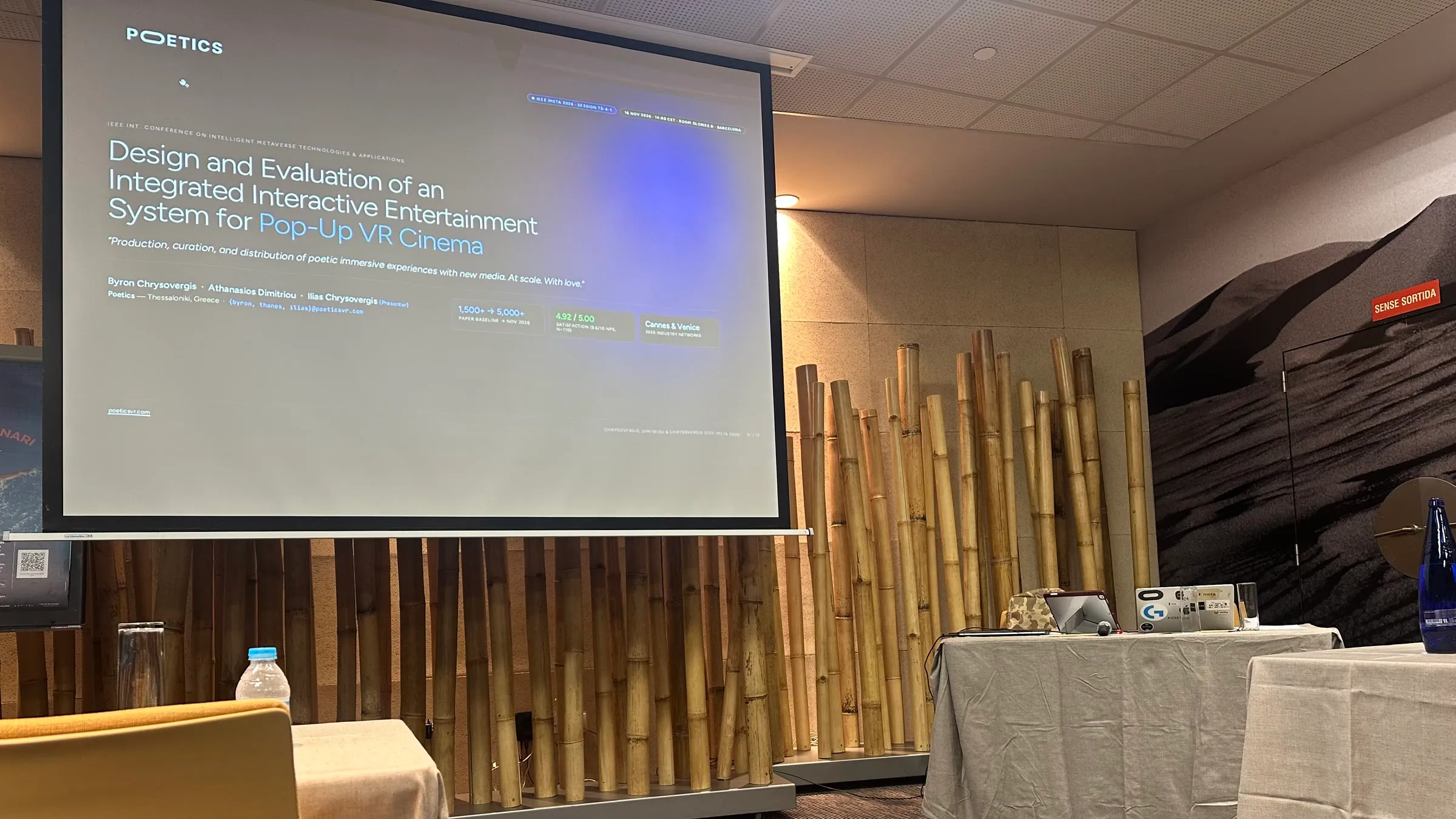
Most of our year is spent in rooms full of swivel chairs, headphones and people trying a headset for the first time. On Monday 16 November we stood in a different kind of room: Room Glories D in Barcelona, in front of researchers and engineers, explaining what it takes to run a pop-up VR cinema.
The occasion was IEEE iMETA 2026, the 4th International Conference on Intelligent Metaverse Technologies and Applications. We presented our paper, Design and Evaluation of an Integrated Interactive Entertainment System for Pop-Up VR Cinema, written by Byron Chrysovergis, Athanasios Dimitriou and Ilias Chrysovergis.
Why we wrote it down
We did not start Poetics to publish research. We started it to show good immersive films properly, in galleries, festivals and cultural venues, to people who had never watched a film in a headset.
Our first 1,500 screenings were run largely by hand, and they taught us where things break in a real venue:
- Large 360° films had to be copied onto each headset, one at a time.
- Tickets had no link to which headset sat on which chair.
- The person running the room had no single place to start a session together, or to pause it for someone who felt unwell.
- Visitor feedback ended up in spreadsheets instead of reaching the filmmakers.
Nothing we could buy solved all four for a small team running pop-up events. So we started building our own tools, and the paper documents what we built and what we learned on the floor.
The operator as a conductor
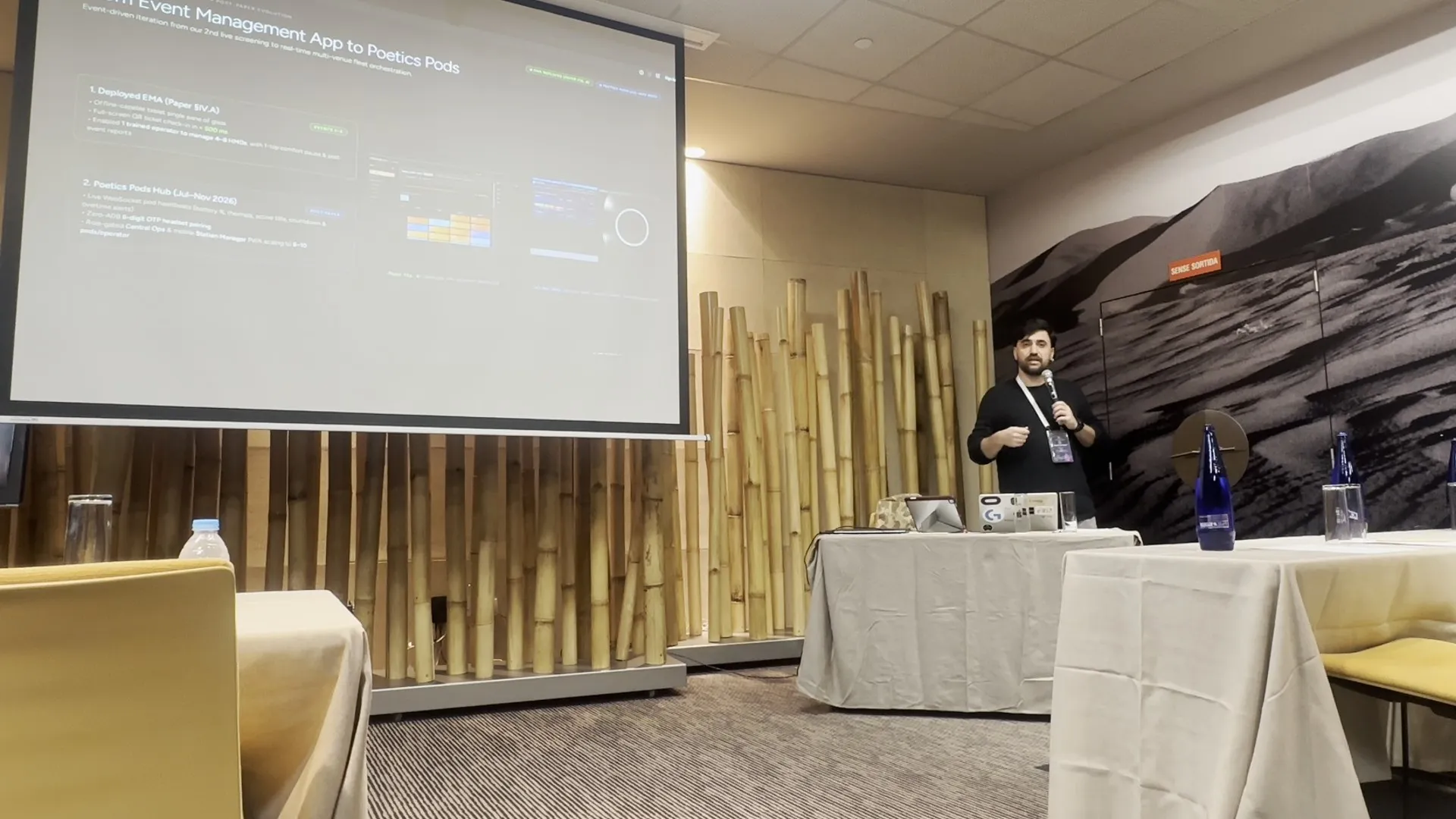
The idea at the center of the paper is simple: the person running the room is a conductor, not a technician. Software should keep the headsets, the timing and the playback in order, so that the team can spend its attention on the visitors.
That matters because of who sits in our pods. If someone leaves confused or uncomfortable, they rarely blame the film. They blame VR. Every minute an operator spends fixing a headset is a minute not spent welcoming someone.
What the first events showed
The paper reports on our first five event editions at three venues: Toss Gallery in Thessaloniki (twice), Technopolis City of Athens (twice) and Bannie SKG in Thessaloniki. Across more than 1,500 screenings of 14 films, 110 visitors filled in our feedback form.
- 4.92 out of 5 for how satisfied they were
- 9.6 out of 10 for how likely they were to recommend us
- 4 to 8 headsets run by a single trained operator
Those scores come from screenings that were still mostly manual. We read them as the standard our tools have to protect, not as proof that the tools work.
From the paper to the road
Research moves slower than events. Between submitting the paper and presenting it in November, our tools kept changing in the field.
Our first event app grew into Poetics Pods, which shows the operator the state of every headset from one tablet. We also set up our headsets so that a visitor who puts one on sees only the Poetics screen, never a menu or a store.
In the same months we took the cinema on a 16-stop tour of Greece. Today we have passed 5,000+ screenings, with the same 4.92 out of 5 rating and more than 250 five-star reviews.
Questions from the room
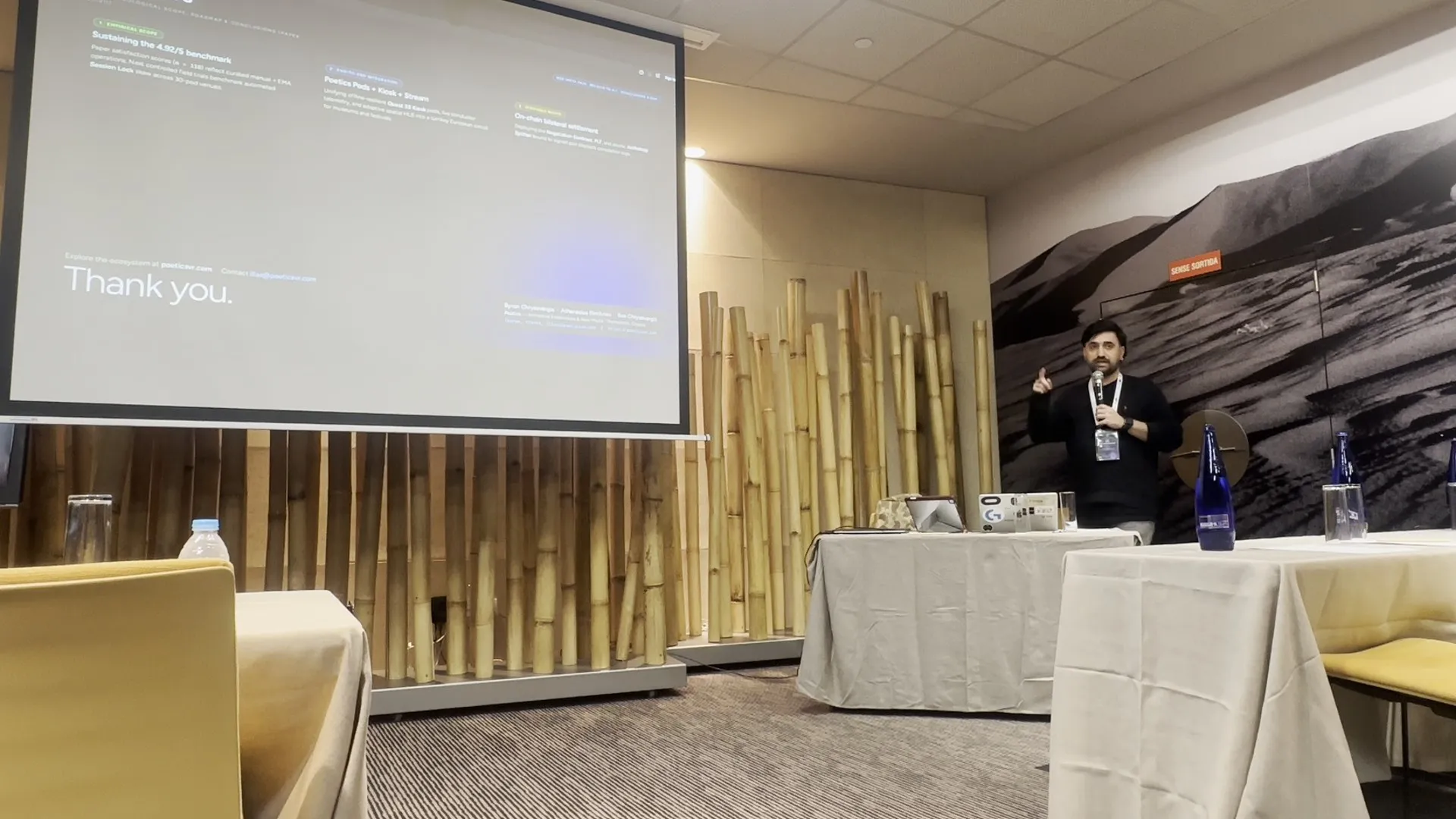
The questions after the talk went straight to what it is like to run a physical VR room.
One engineer asked how a visitor can stay inside our screen without losing the headset’s safety boundary, the virtual wall that warns you before you walk into something. The answer is that the boundary stays on; we only hide what a first-time visitor does not need to see.
Another asked whether everyone in a group session watches the same film at the same moment. At first, each visitor watched on their own. We added synchronized group viewing later, because so many people arrive with friends and want to share the moment.
Festivals are where we talk about films. Barcelona was where we showed the work underneath them.
→ Learn more: how a Poetics cinema works